
Who this is for: OEM buyers and product owners who are comparing Asian injection molding suppliers at a regional level. If you already know the country, use the country guides; if you are still deciding where to look, this page gives you the comparison framework.
Quick answer
Asia is not one supply base. China has the deepest tooling and injection molding cluster. Southeast Asia offers lower-cost production and supply-chain diversification, with Thailand, Vietnam, Malaysia and Cambodia playing different roles. South Asia is a large buyer market with growing manufacturing, but tooling depth, quality systems and logistics vary widely. The right choice depends on the part, tooling complexity, audit requirements, volume and destination.
Cambodia's place in Asia
Cambodia is in Southeast Asia, west of Vietnam and east of Thailand, with Laos to the north. It is not in South Asia. The Everest factory is in Kampong Speu province, in western Cambodia, with road access toward Phnom Penh and the Sihanoukville port corridor. This location matters for material imports, mold transfer and export routing.
Three layers of an Asia sourcing decision
| Layer | Question | What to compare |
|---|---|---|
| Tooling | Where will the mold be designed, built and maintained? | Mold cluster depth, multi-cavity experience, hot runner, steel, texture, trial iteration and repair response. |
| Production | Where will the parts be molded, finished and assembled? | Machine tonnage, mold compatibility, secondary operations, labor intensity, capacity and shift pattern. |
| Compliance and logistics | Can the factory support the destination market? | Social compliance, factory capability audits, product safety documents, origin rules, freight and documentation. |
China, Southeast Asia and South Asia
China
China remains the deepest cluster for complex molds, multi-cavity tools, hot runners and fast engineering iteration. Buyers use China when tooling depth and speed matter most, or when the product needs a mature supplier ecosystem. The trade-off is tariff and origin exposure for some destination markets, which is why many buyers evaluate a second production country.
Southeast Asia
Southeast Asia is diverse. Vietnam has a larger mold base and scale in several sectors. Thailand has automotive and electronics clusters with strong local engineering. Malaysia is strong in electronics and medical devices with English-speaking project teams. Cambodia has a smaller precision mold base but can be competitive for labor-intensive assembly, China mold transfer, retail compliance and China-plus-one production.
South Asia
South Asia usually refers to India, Bangladesh, Pakistan, Sri Lanka and Nepal. It is a large buyer market with growing manufacturing capacity, but tooling depth, quality systems and logistics vary widely by factory and region. Buyers sourcing in South Asia should verify the actual factory, audit evidence and export documentation rather than relying on country-level assumptions.
How to shortlist Asian suppliers
- Start with the part. Define material, tolerance, cosmetic requirements, annual volume and assembly. Without this, country comparisons are abstract.
- Separate tooling from production. A supplier may build molds in one country and run production in another. Confirm both locations.
- Check machine fit. Tonnage range alone is not enough. Confirm tie-bar spacing, shot size, mold dimensions and material.
- Verify audit evidence. Ask for current social compliance and factory capability reports, including scope and date. Everest holds Sedex SMETA 4-Pillar and FCCA Follow-Up PASS, score 84 (28 August 2026).
- Compare total landed cost. Include material imports, packaging, freight, insurance, brokerage and origin rules. Do not compare piece price alone.
- Plan the trial. Agree on T1 samples, inspection criteria, packaging and the ramp-up plan before mass production.
Where Everest fits in Asia
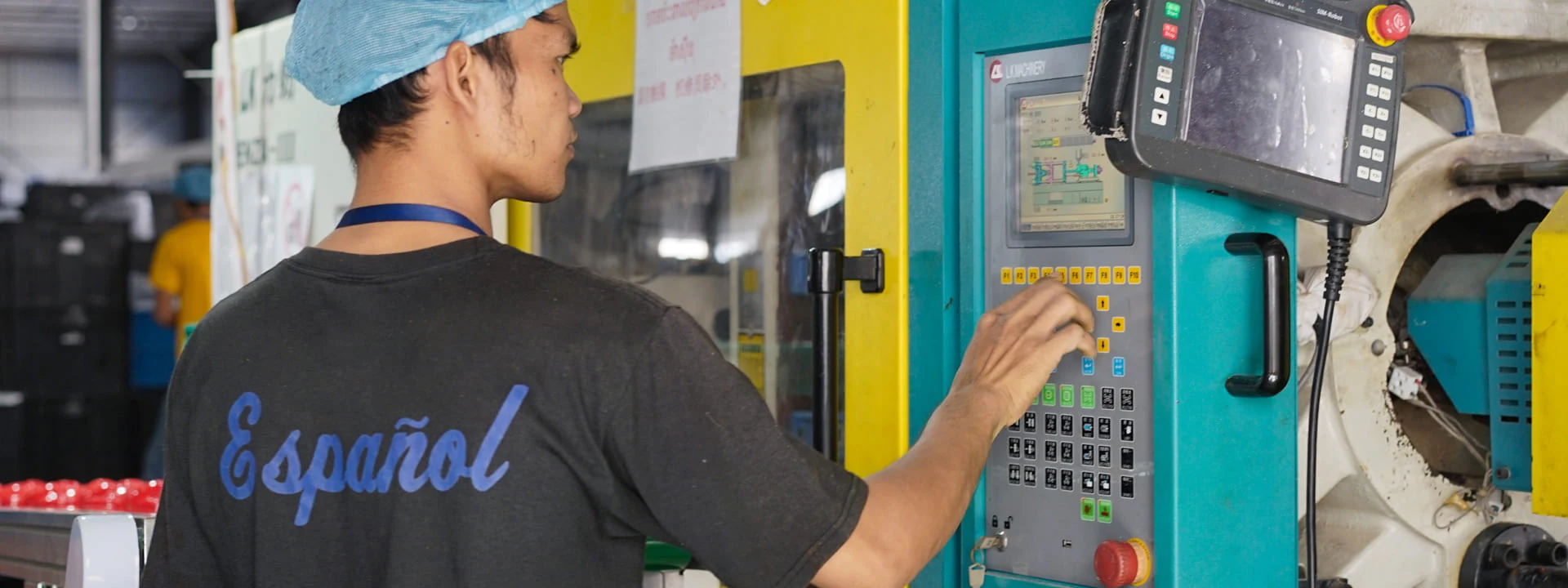
Everest Plastic Mold operates in Cambodia only. The factory lists 16 injection molding machines from 80T to 1000T, about 4,500 m² of production area and overall capacity of about 200,000 pieces per month. In-house operations include injection molding, assembly, spray painting, UV coating, rubber-oil soft-touch coating, pad printing, silk-screen printing, hot stamping and ultrasonic welding. China Tooling Support is provided from Shenzhen by our China company JR Plastic Mold, which has in-house mold manufacturing and large-volume injection molding capability.
This is a fit for buyers who want a Southeast Asia production base with audit evidence and manual finishing, while keeping complex tooling in a deeper cluster. It is not a claim that Everest has factories in Thailand, Vietnam, Malaysia, India, Bangladesh, Pakistan or Sri Lanka.
When an Asia-wide search is the wrong approach
If the project needs a very specific local ecosystem, such as automotive-level validation in Thailand, medical cleanroom production in Malaysia, or a deep local mold cluster in China or Vietnam, start with that country rather than an Asia-wide search. Asia-level content is useful for framing the decision, not for replacing country due diligence.
Next step
Send the drawing, material, annual volume, current mold location and destination market. If the design is not complete, send product photos, intended use, approximate size and expected quantity so the engineering team can identify what is needed next. A formal quote requires a defined part and volume.
Related guides: Cambodia, Southeast Asia, Thailand vs Vietnam vs Malaysia vs Cambodia, Asia sourcing and China Plus One.
Frequently asked questions
What is the best country in Asia for injection molding?
Is Cambodia in South Asia?
Does Everest have factories in multiple Asian countries?
Can South Asian buyers source from Everest?
What should I compare between Asian suppliers?
How does China tooling fit a Cambodia production base?
What audits does Everest hold?
What if my project needs a local mold cluster?
Review an Asia sourcing program
Send the drawing, material, annual volume and destination market.